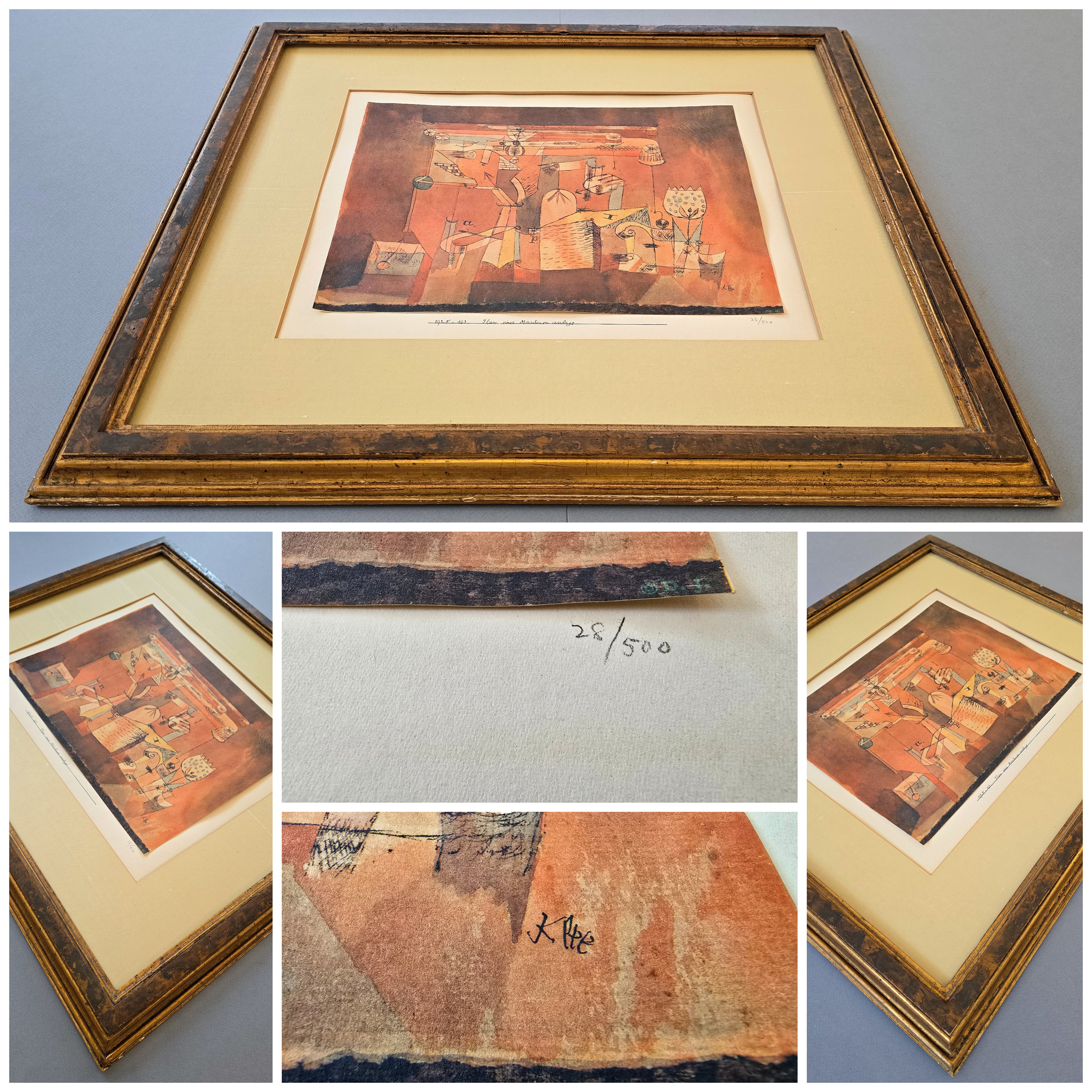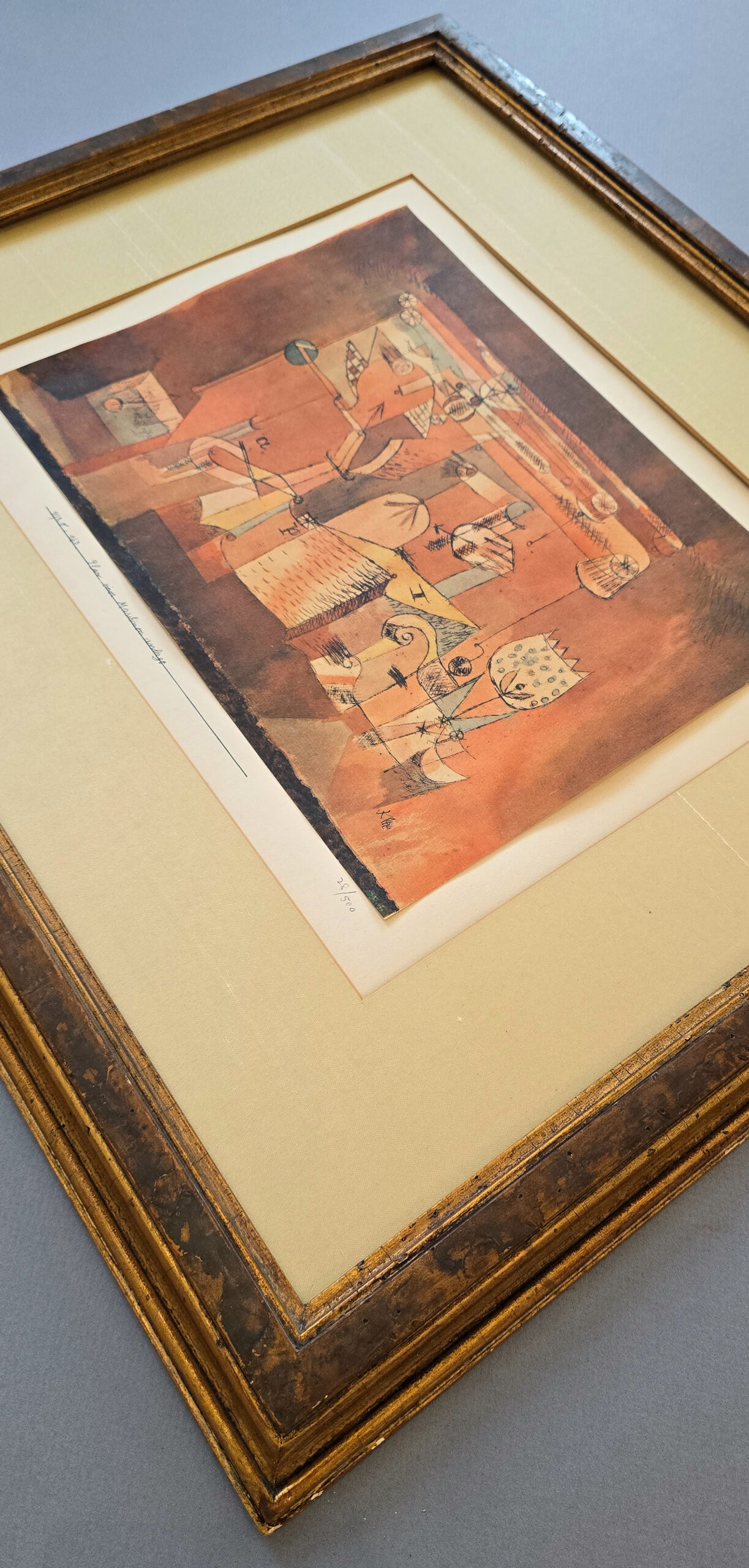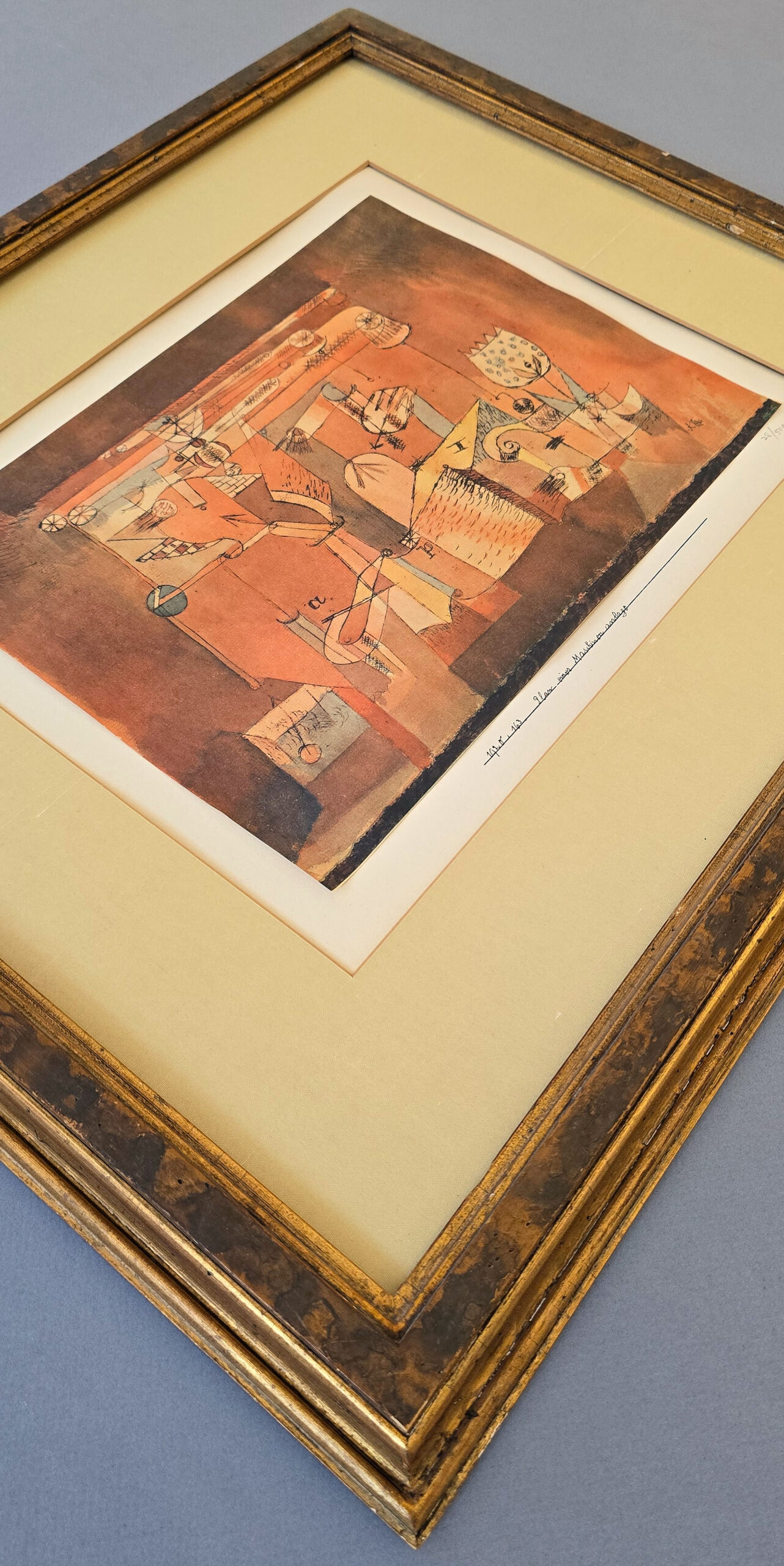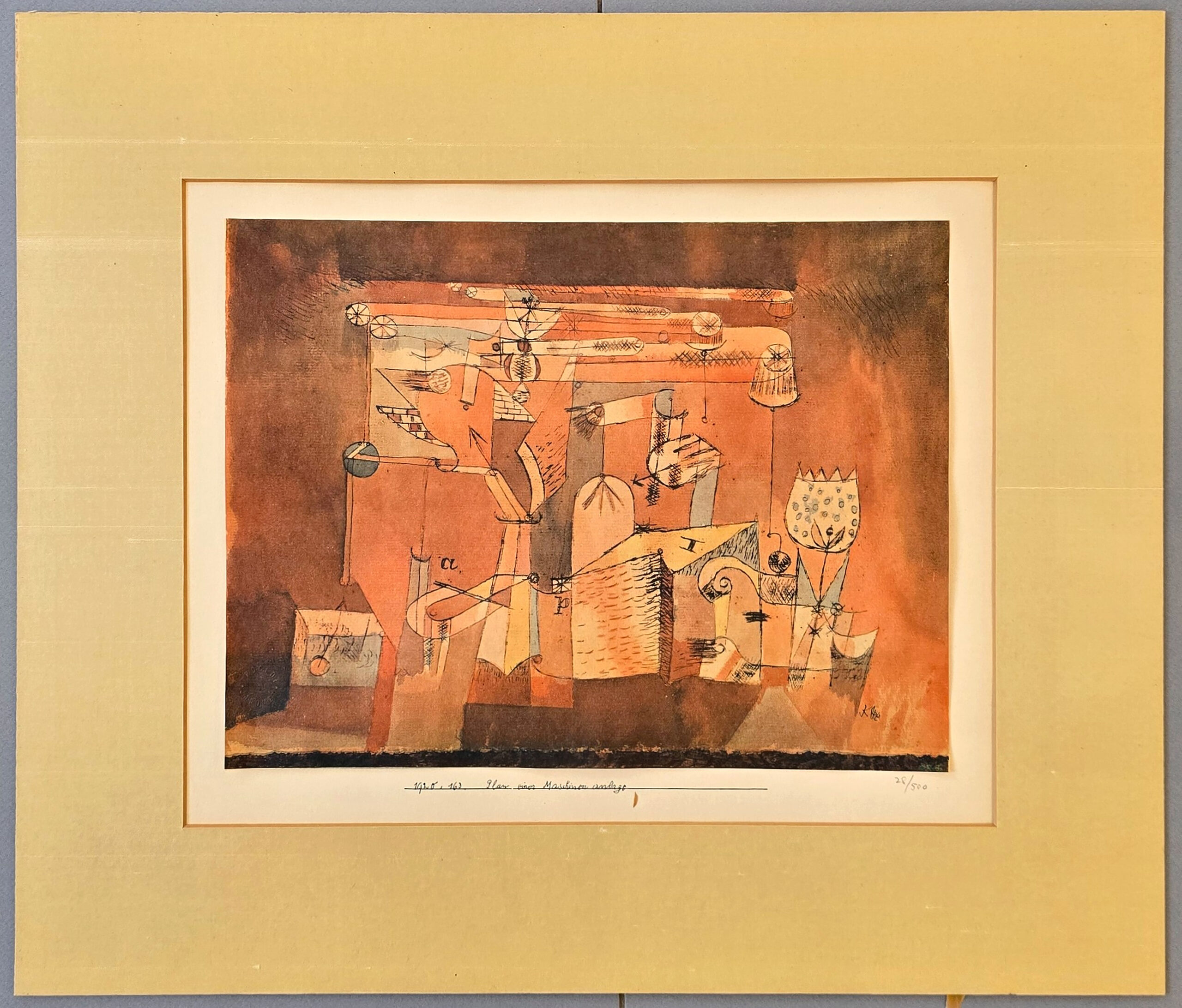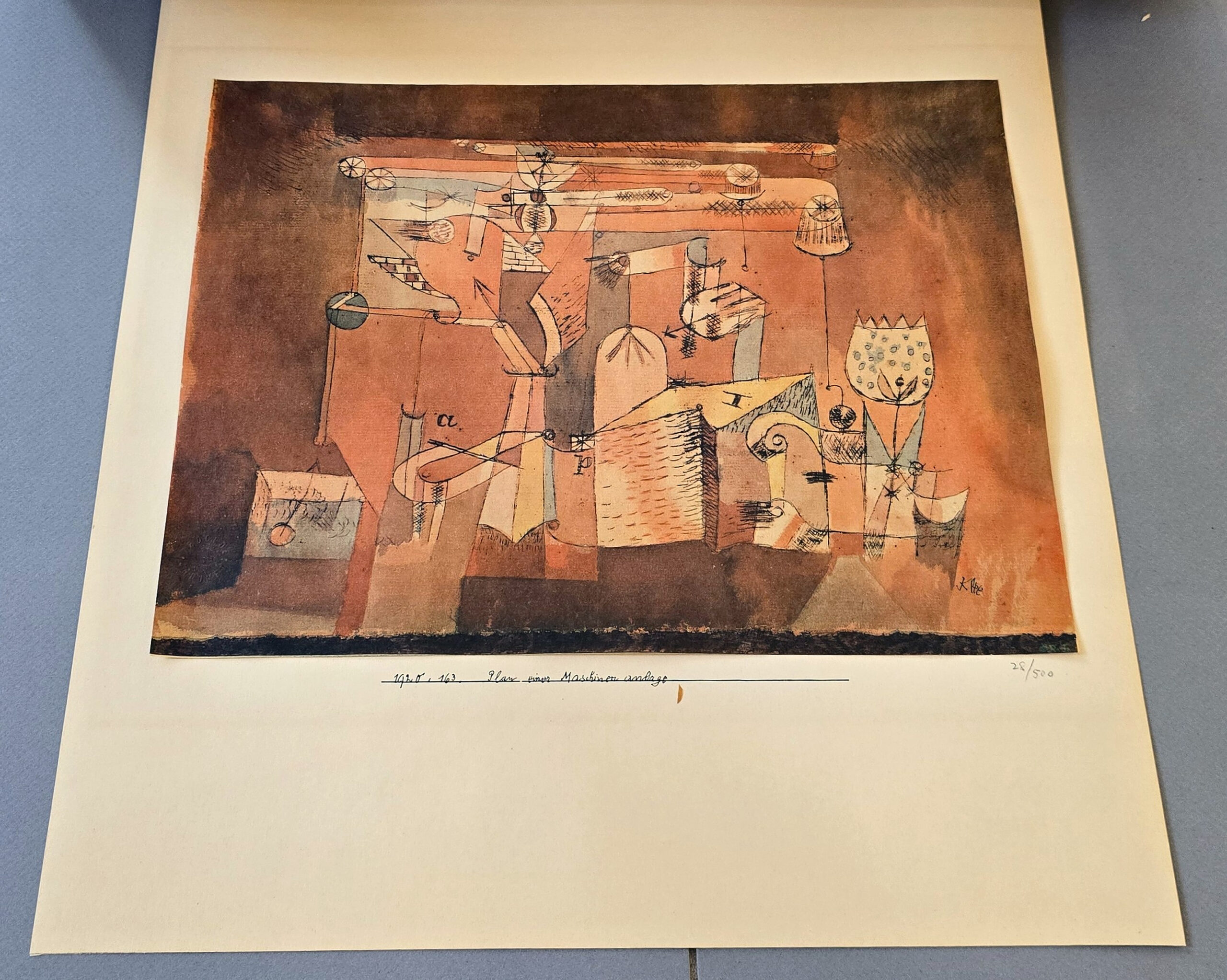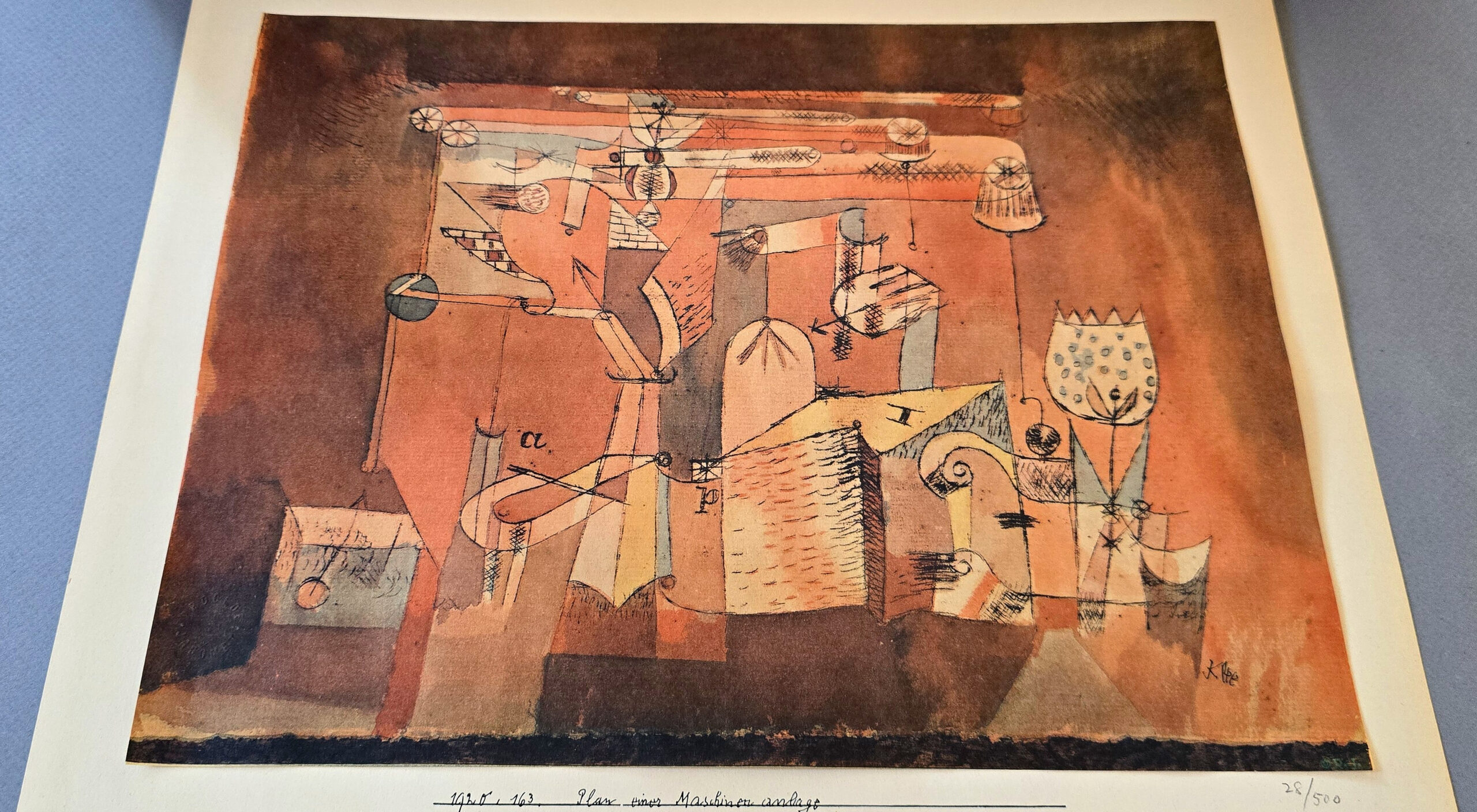
Lithograph and Pochoir (hand-stenciled watercolor) on Vélin de Rives
Image: 9.8 x 13 inches (24.89 x 33.02 cm)
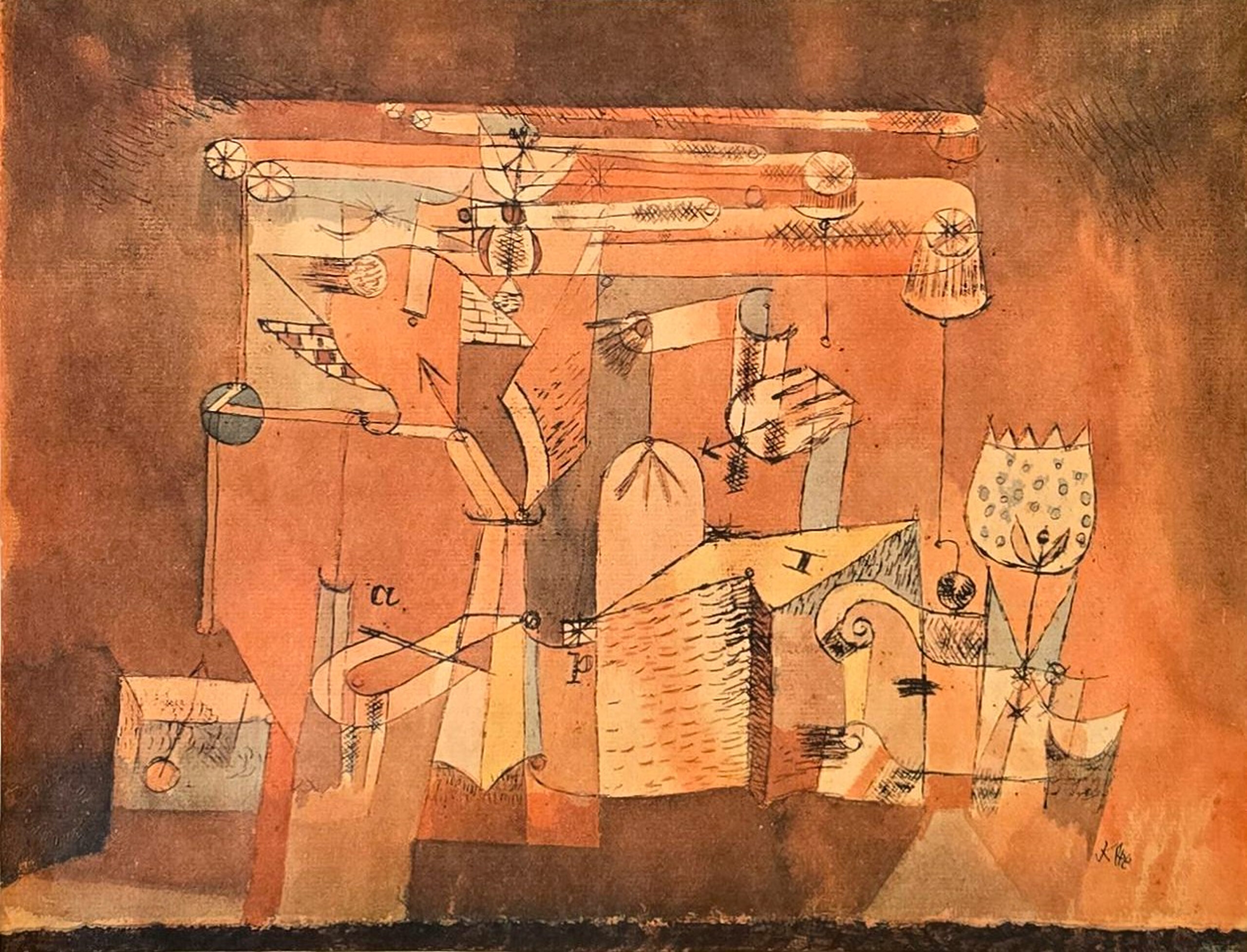
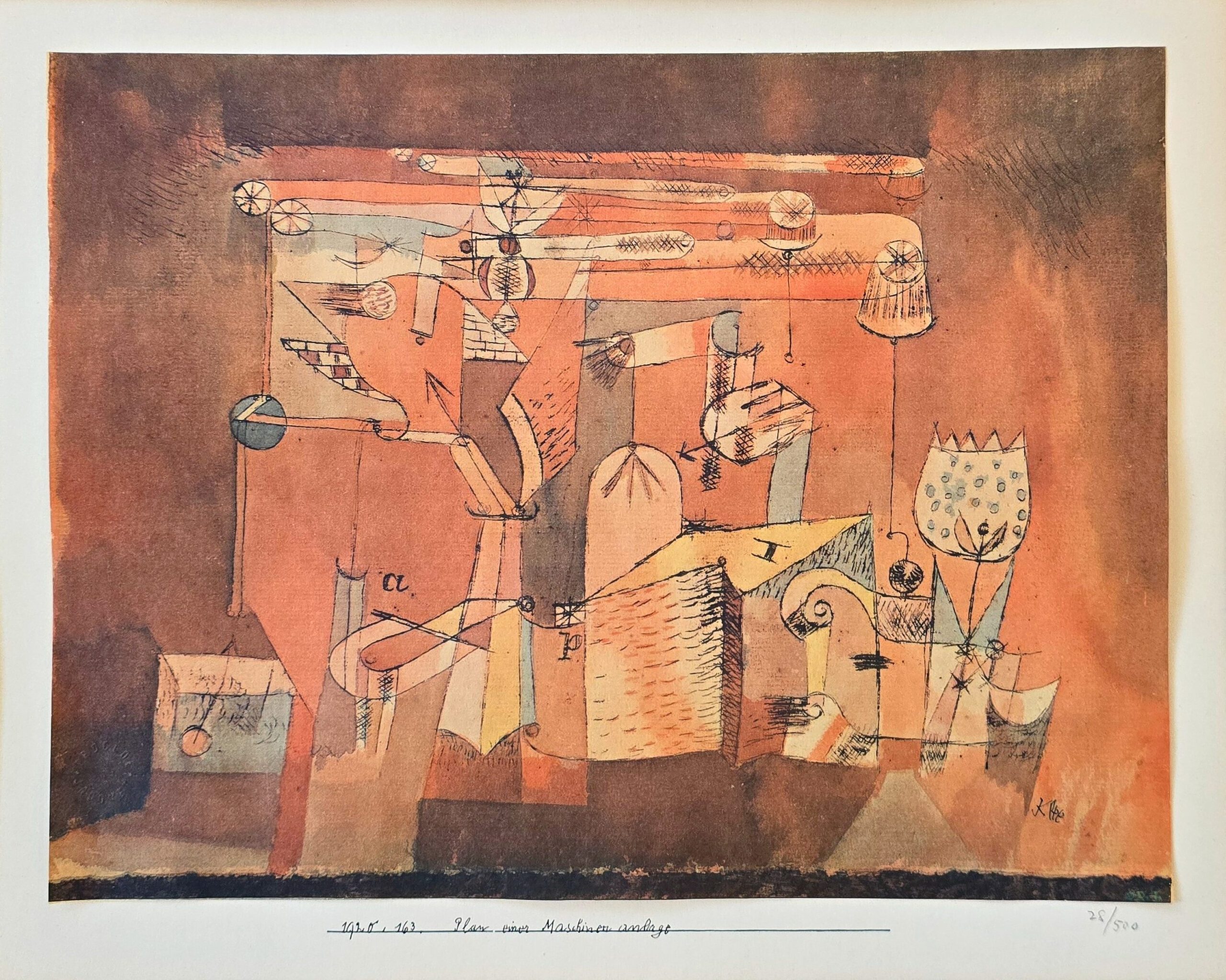
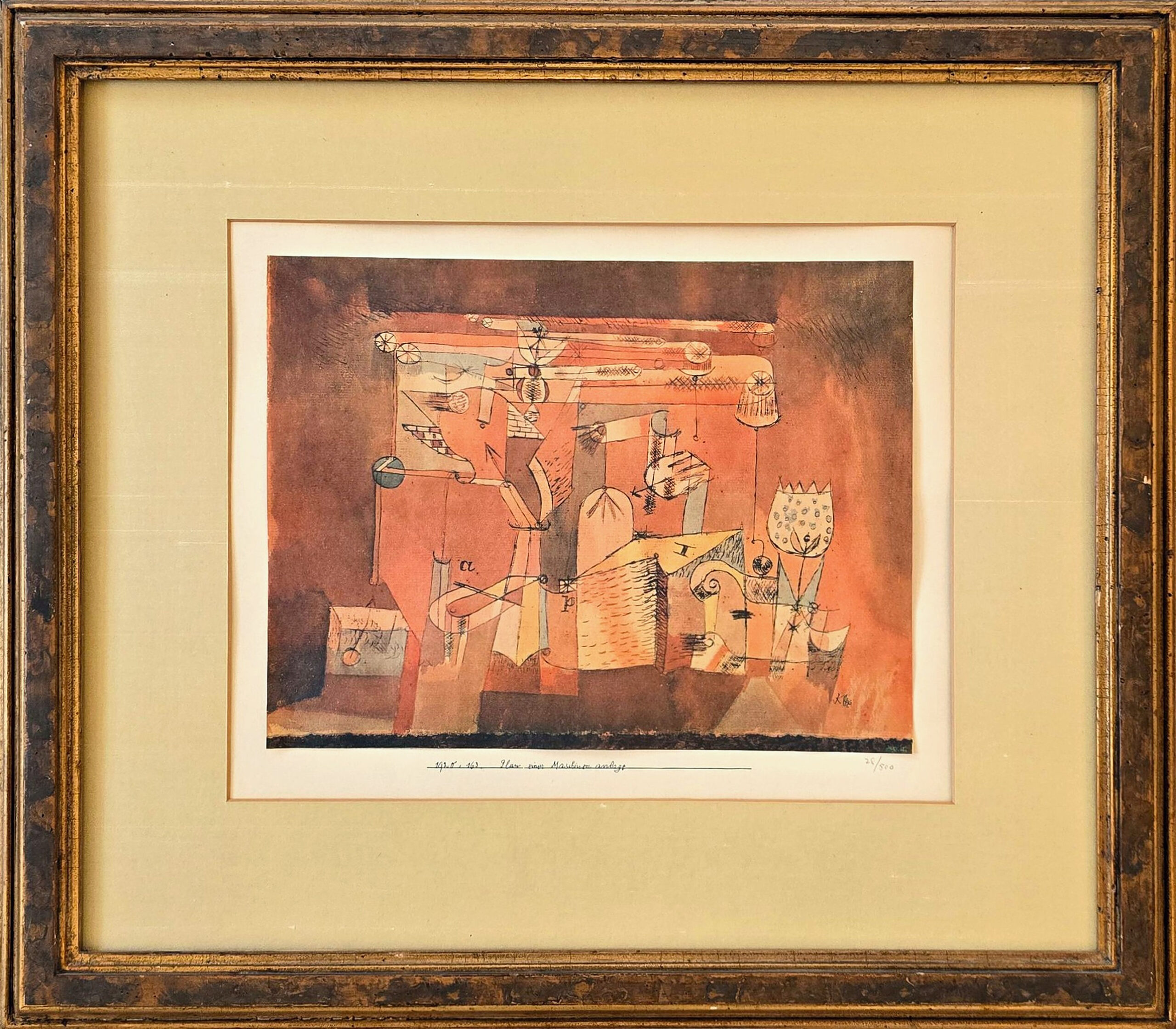
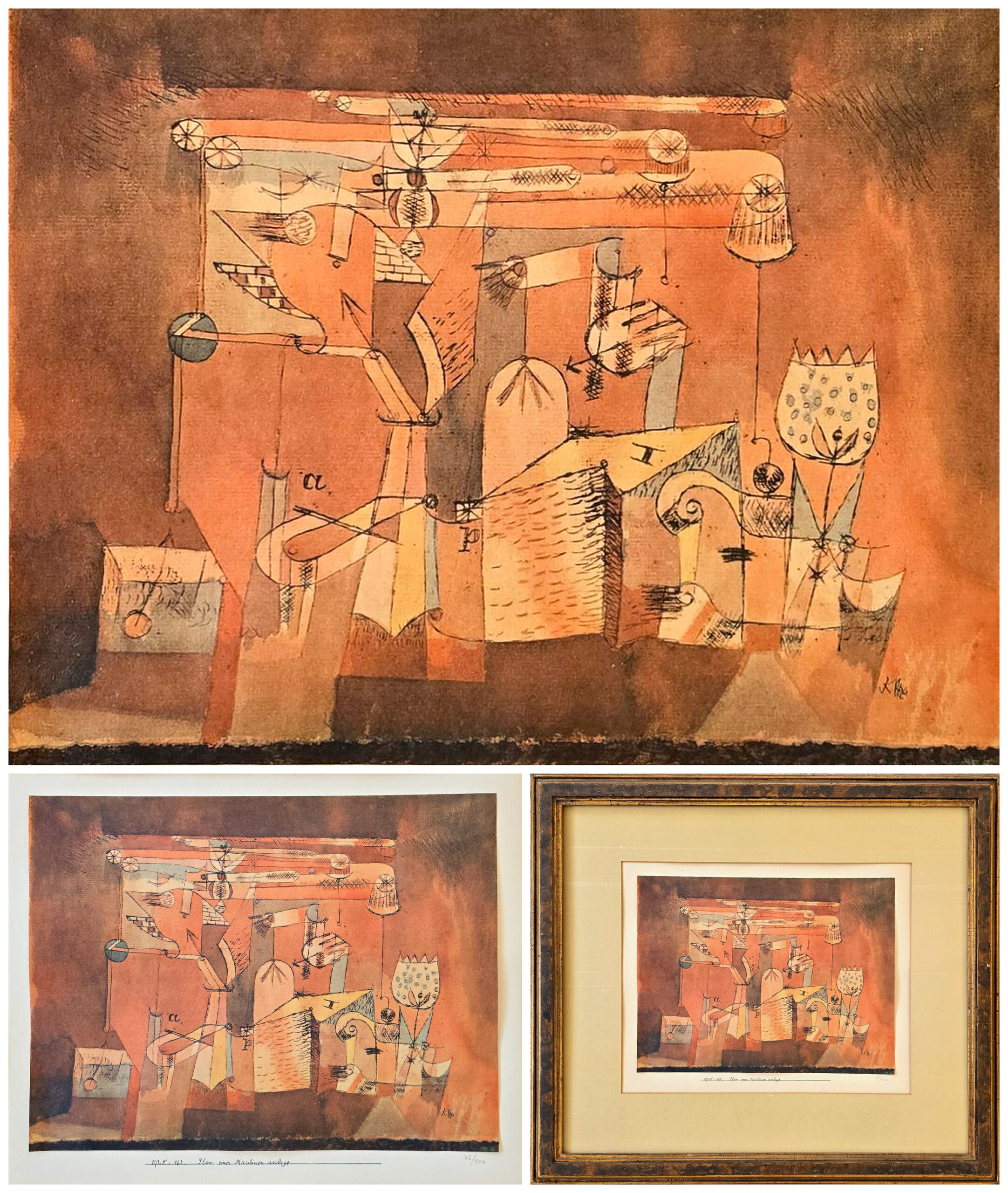
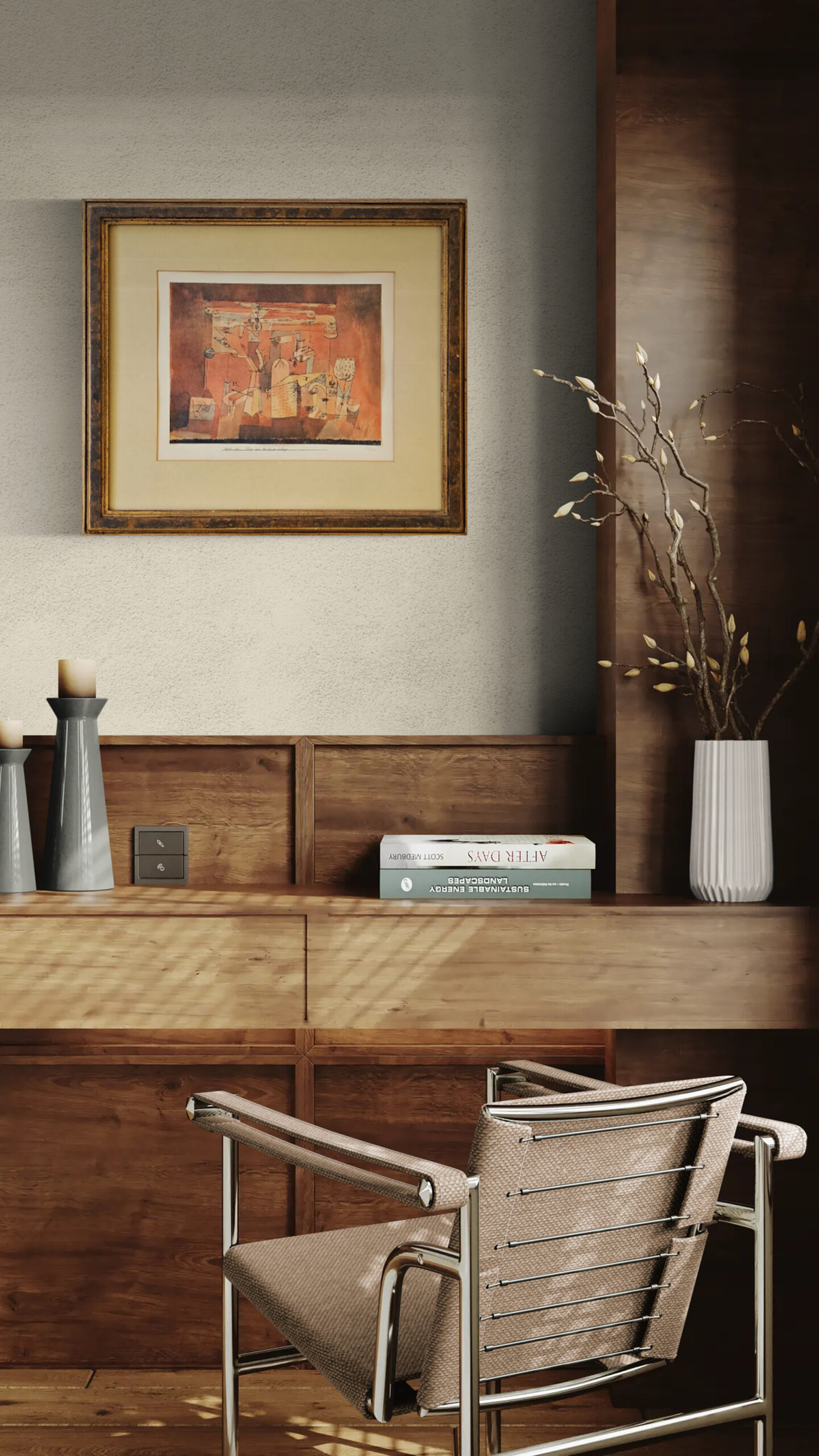
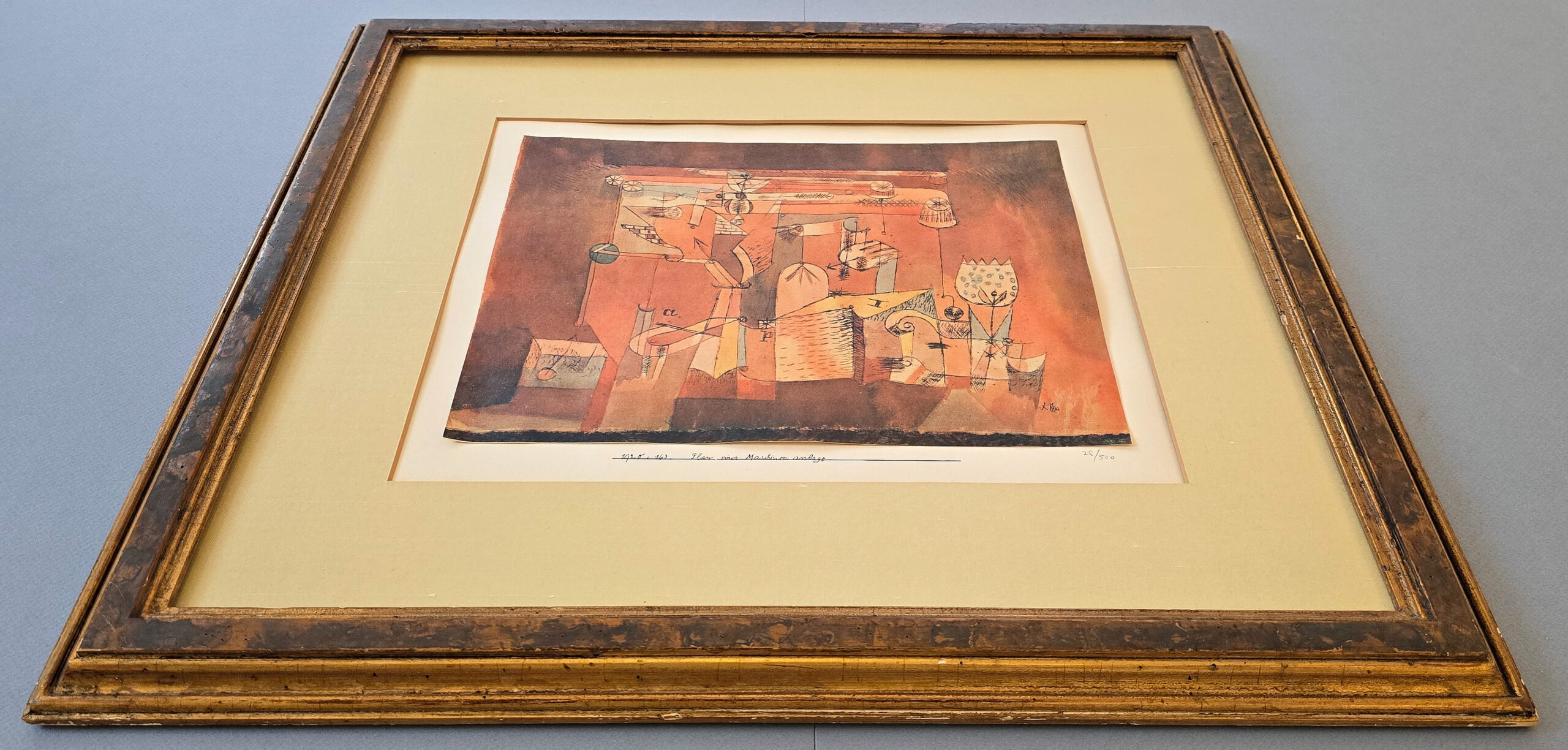
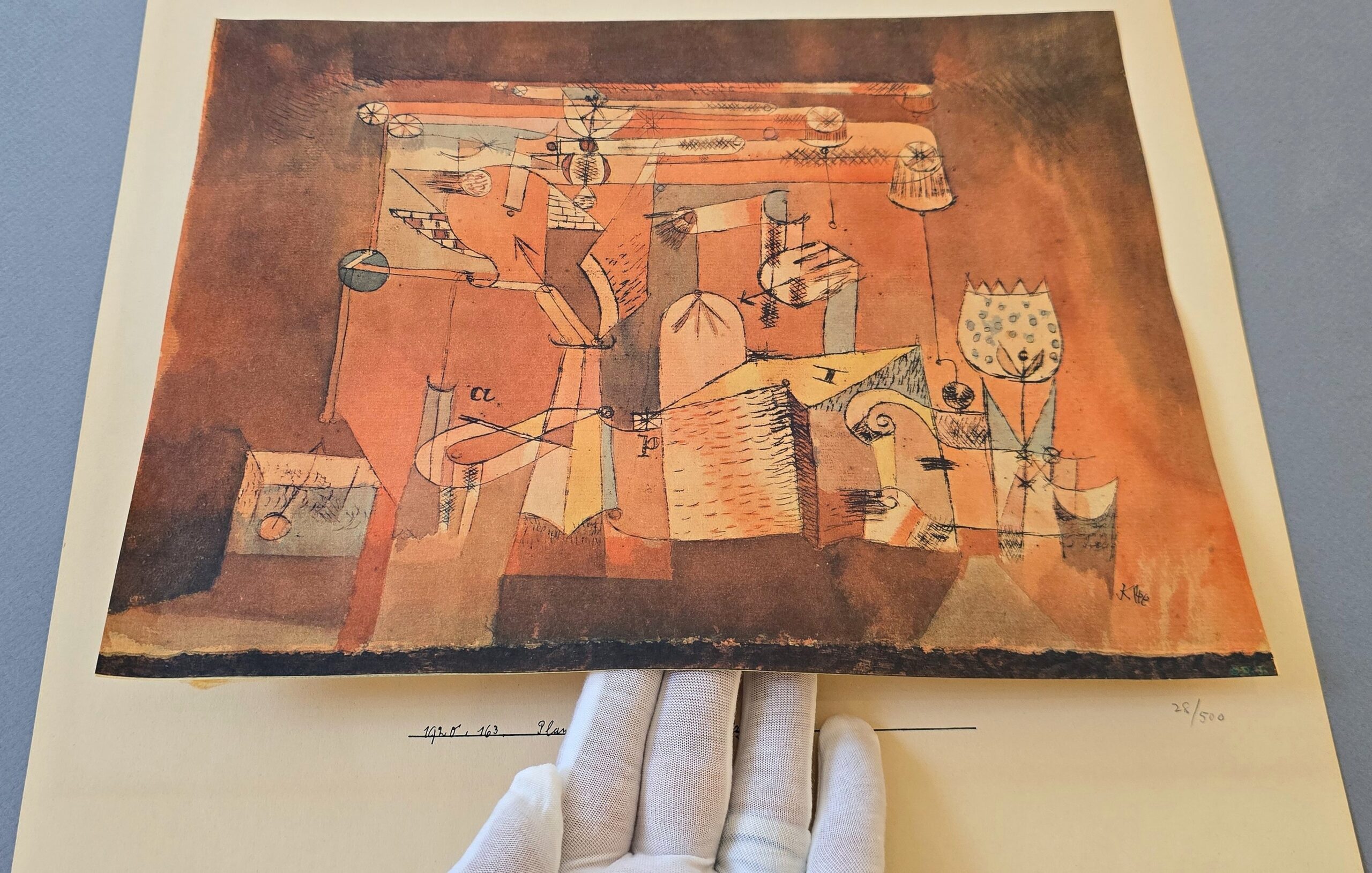
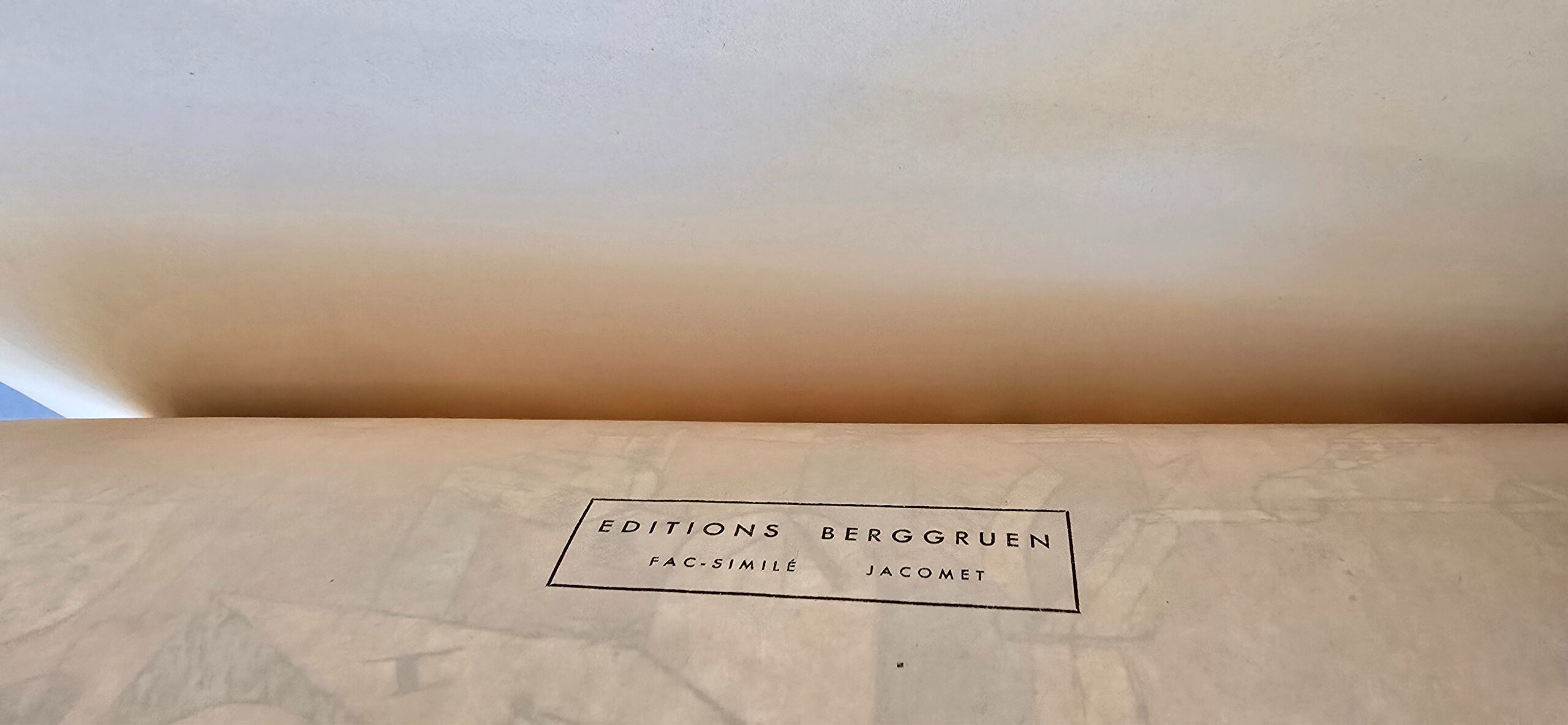
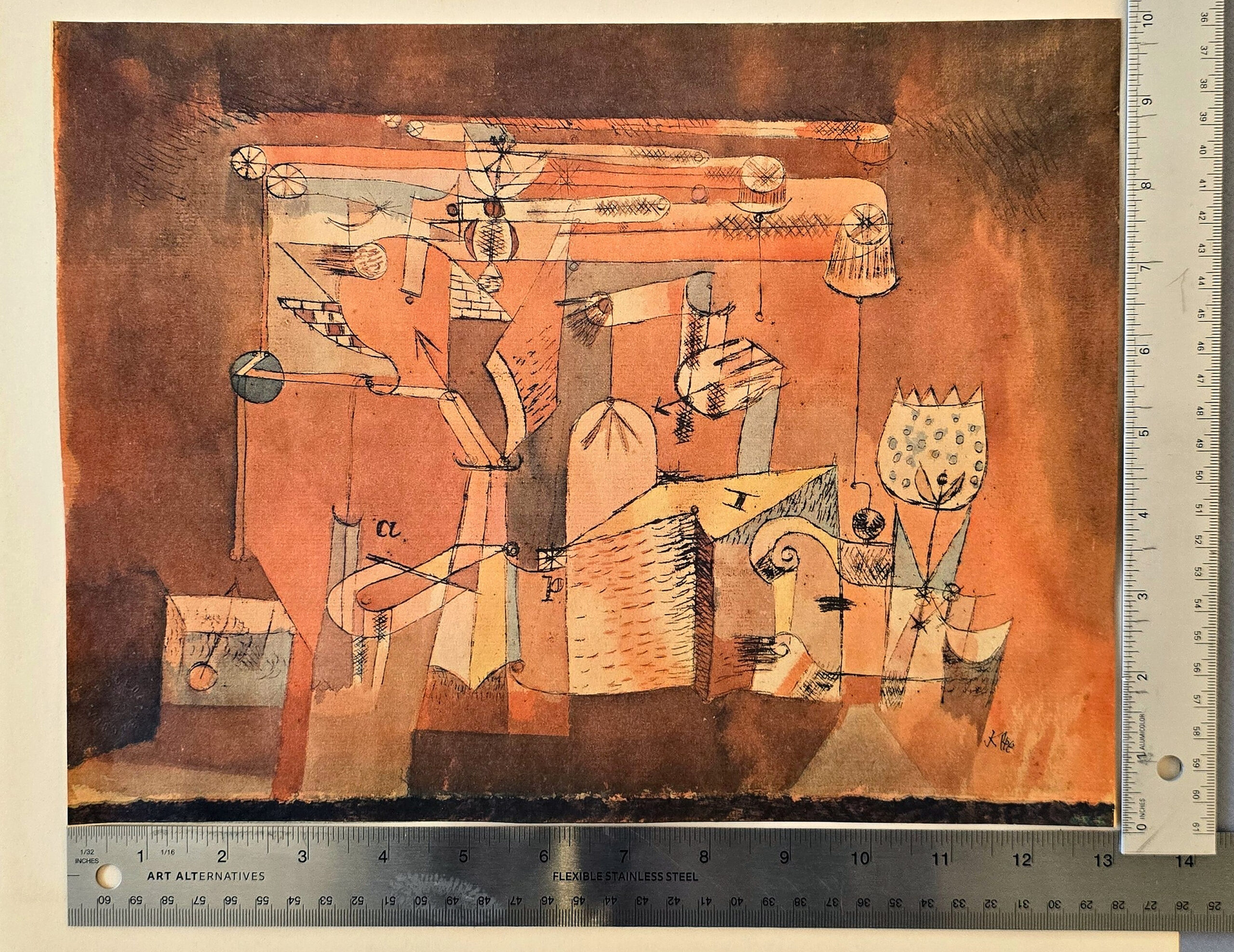
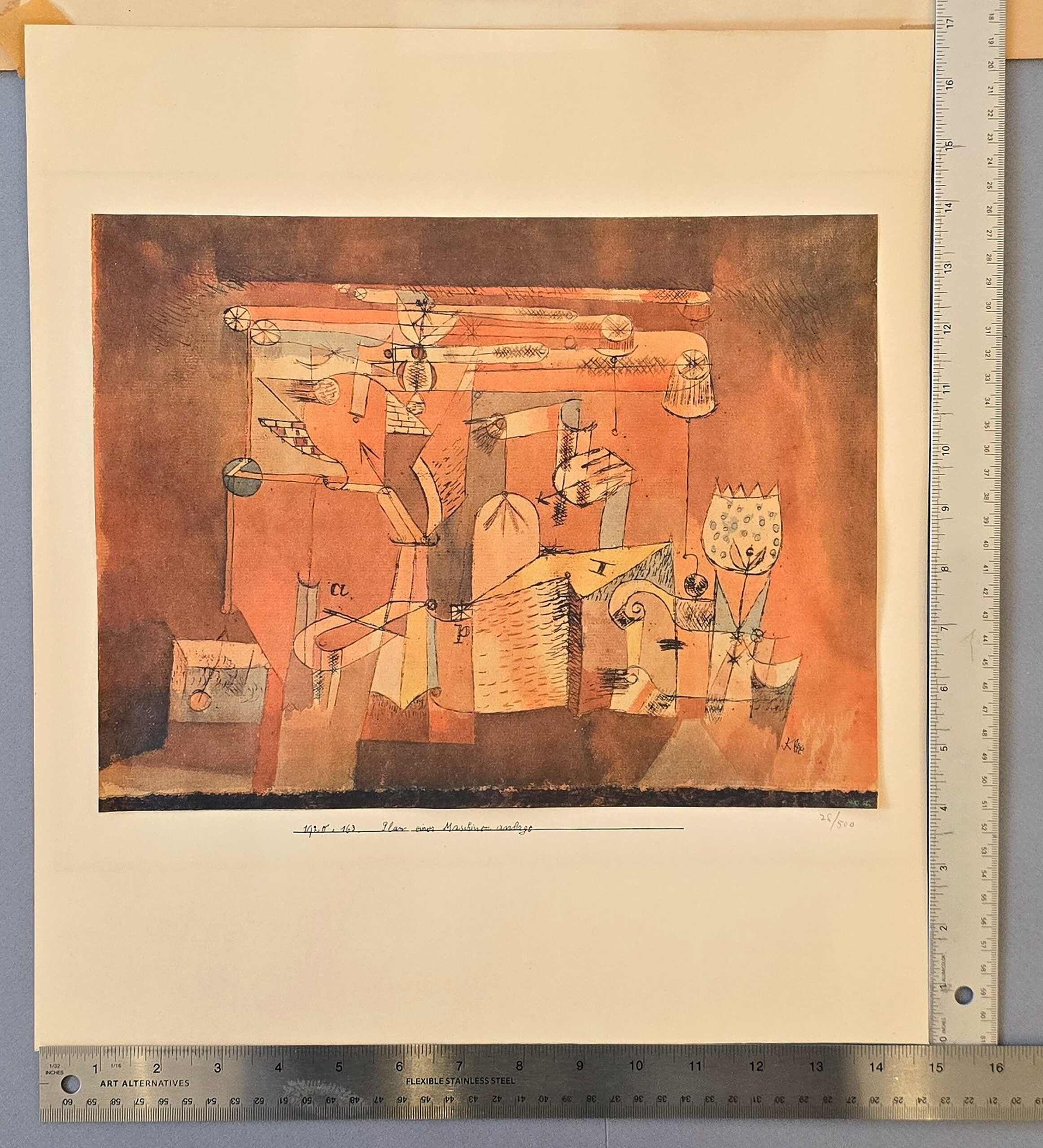
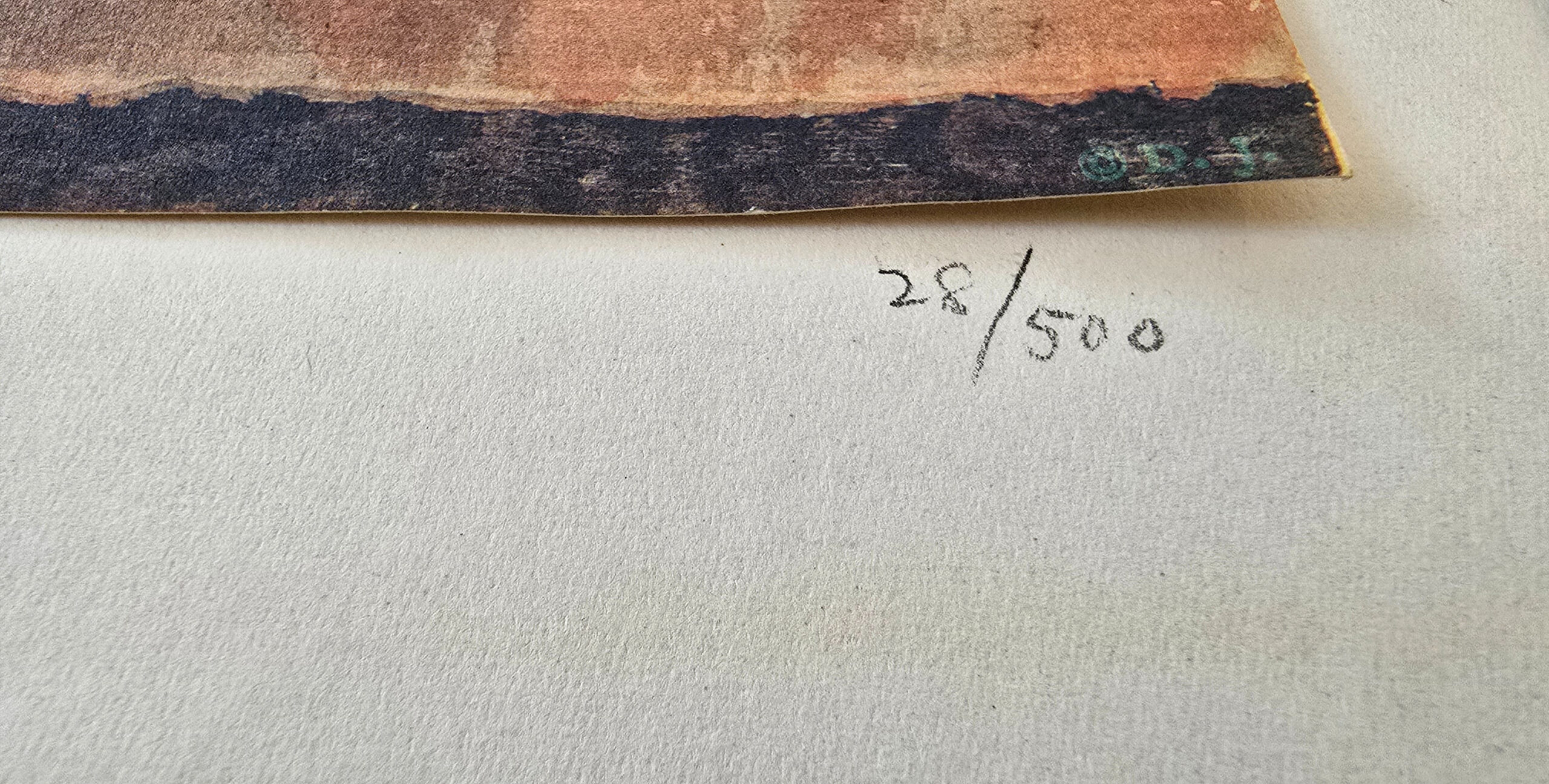
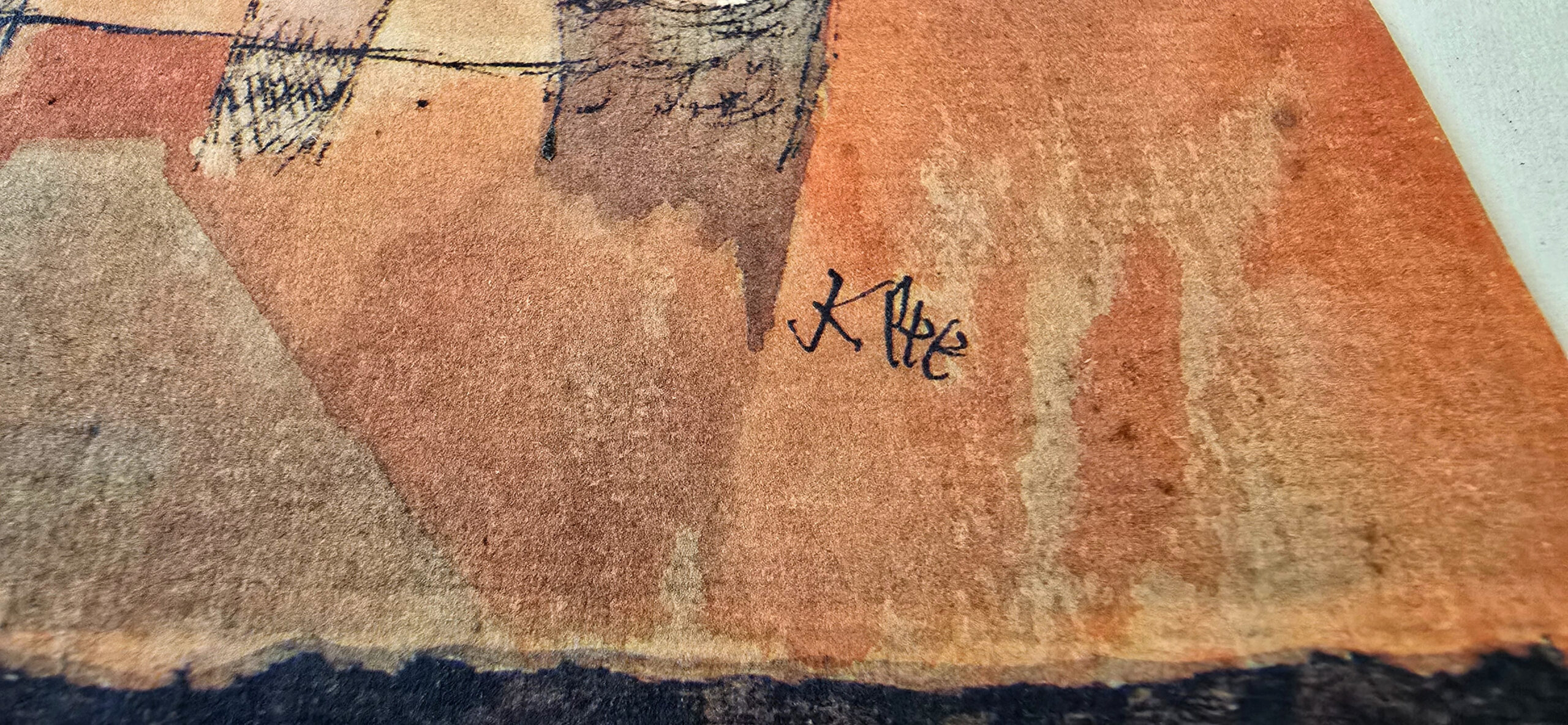
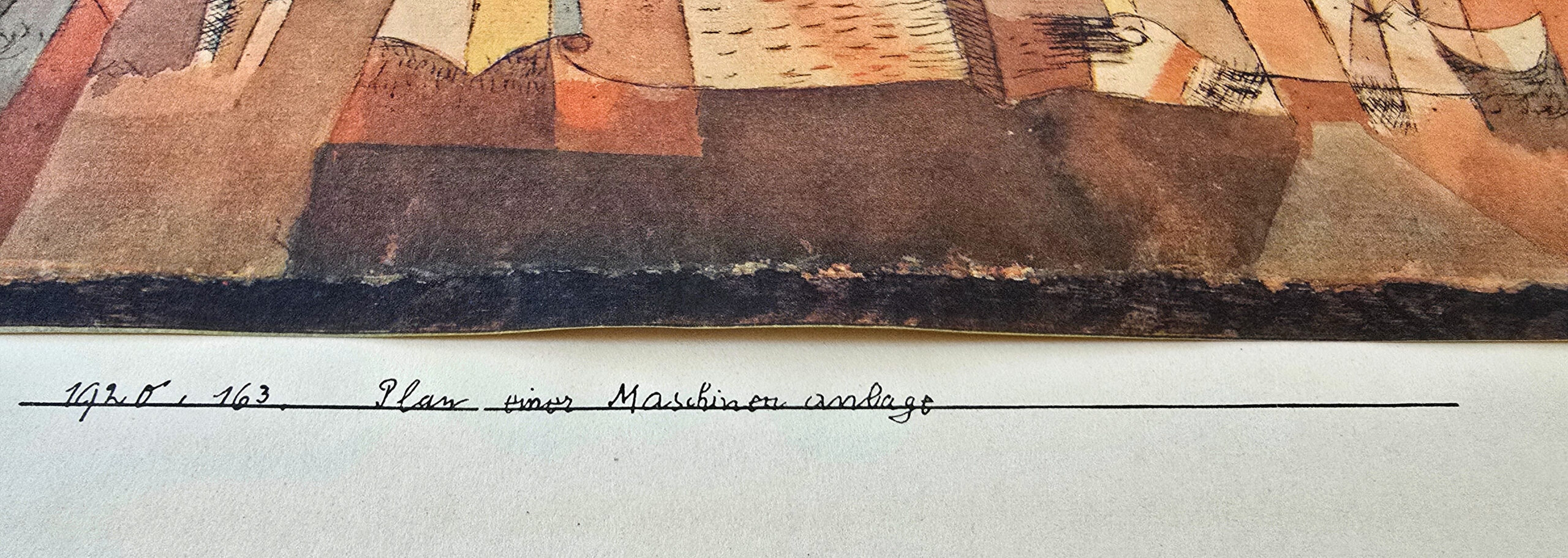
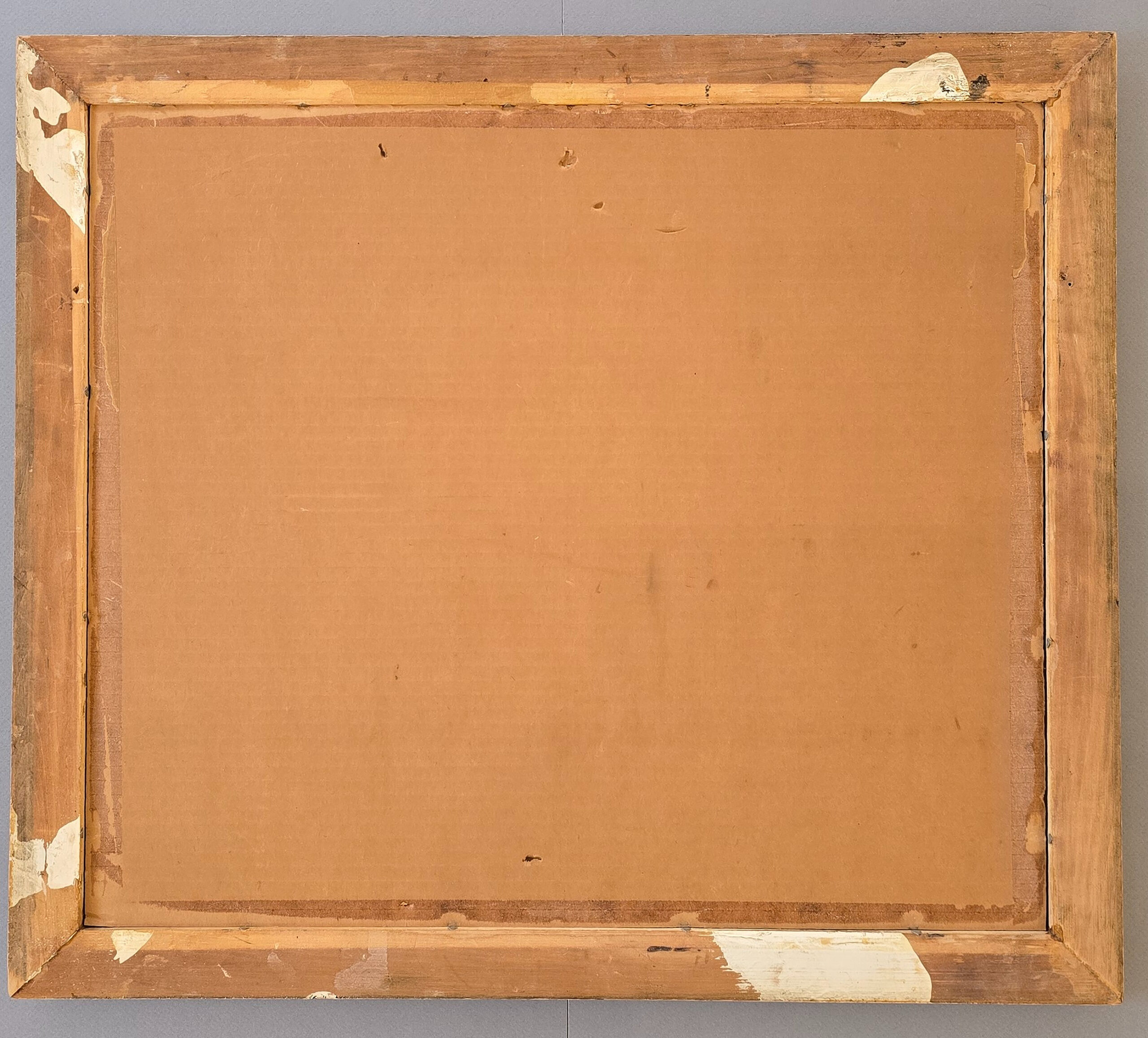
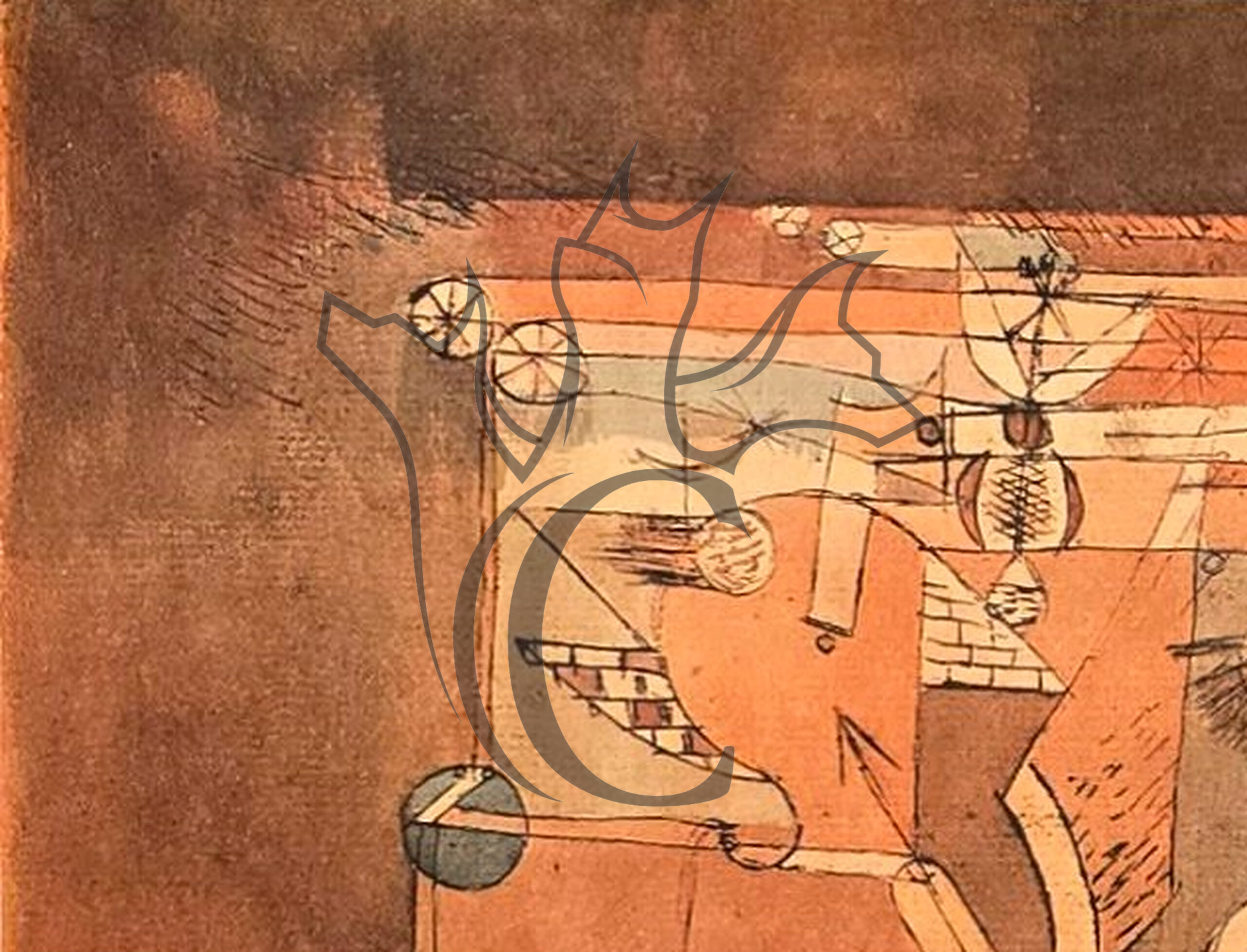
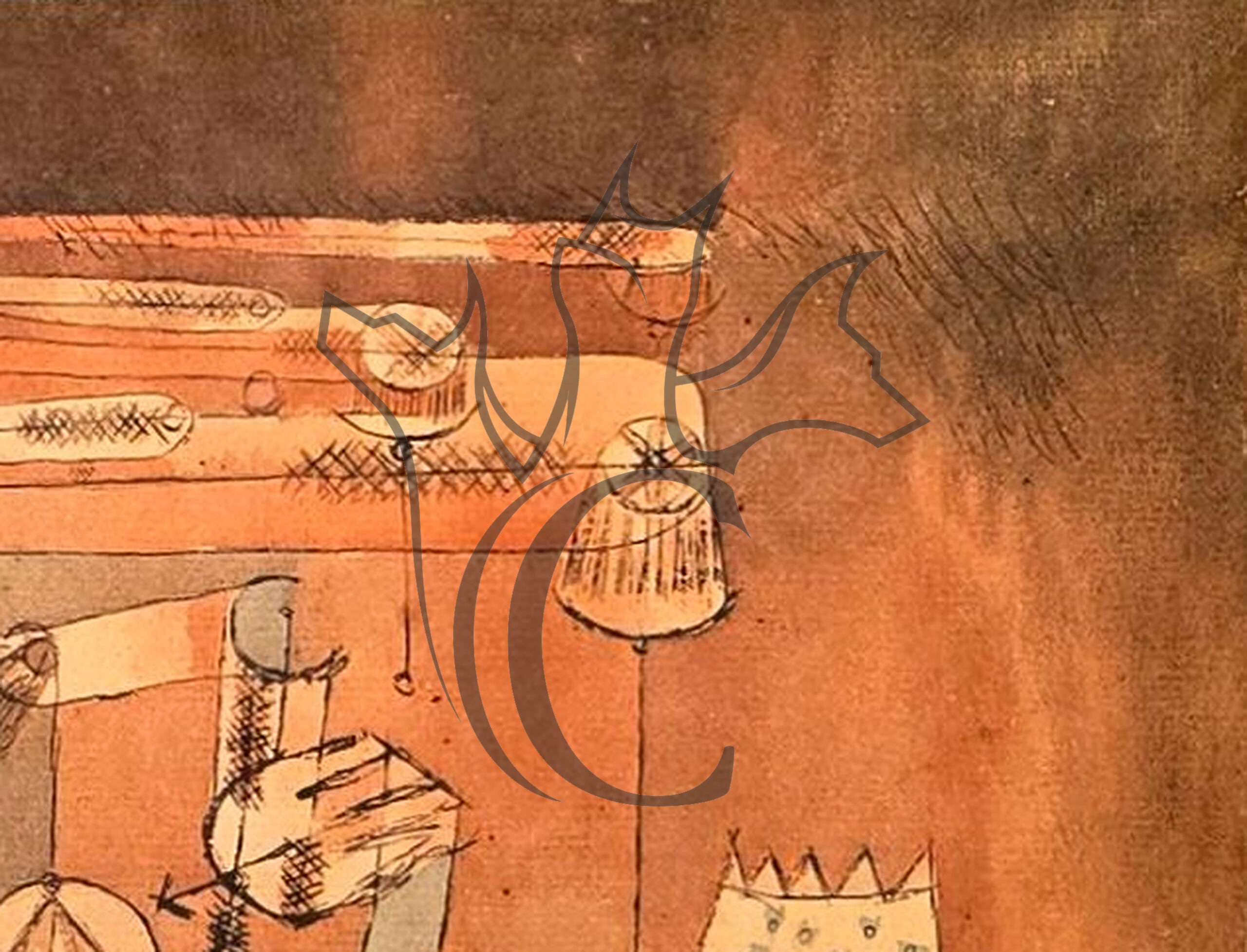
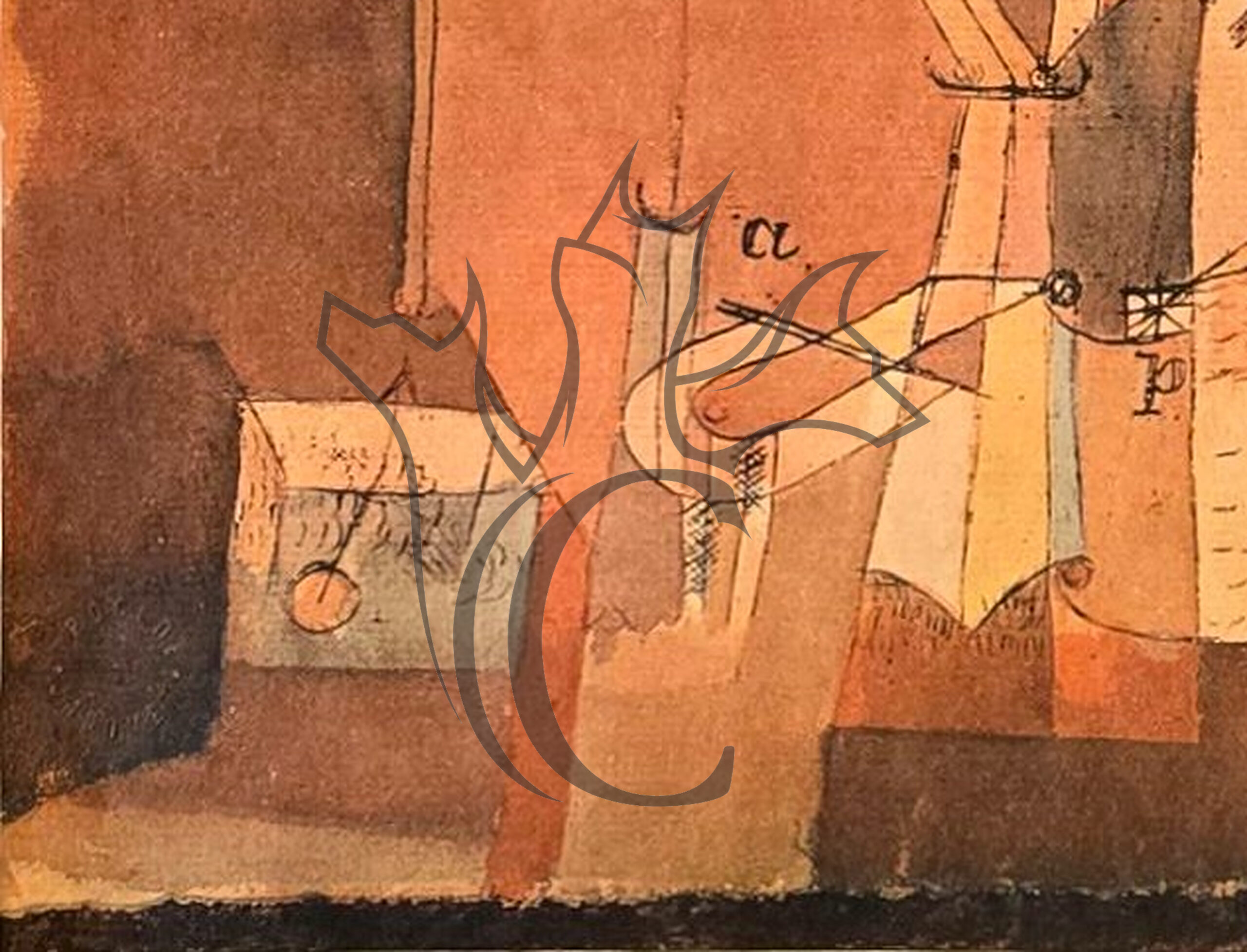
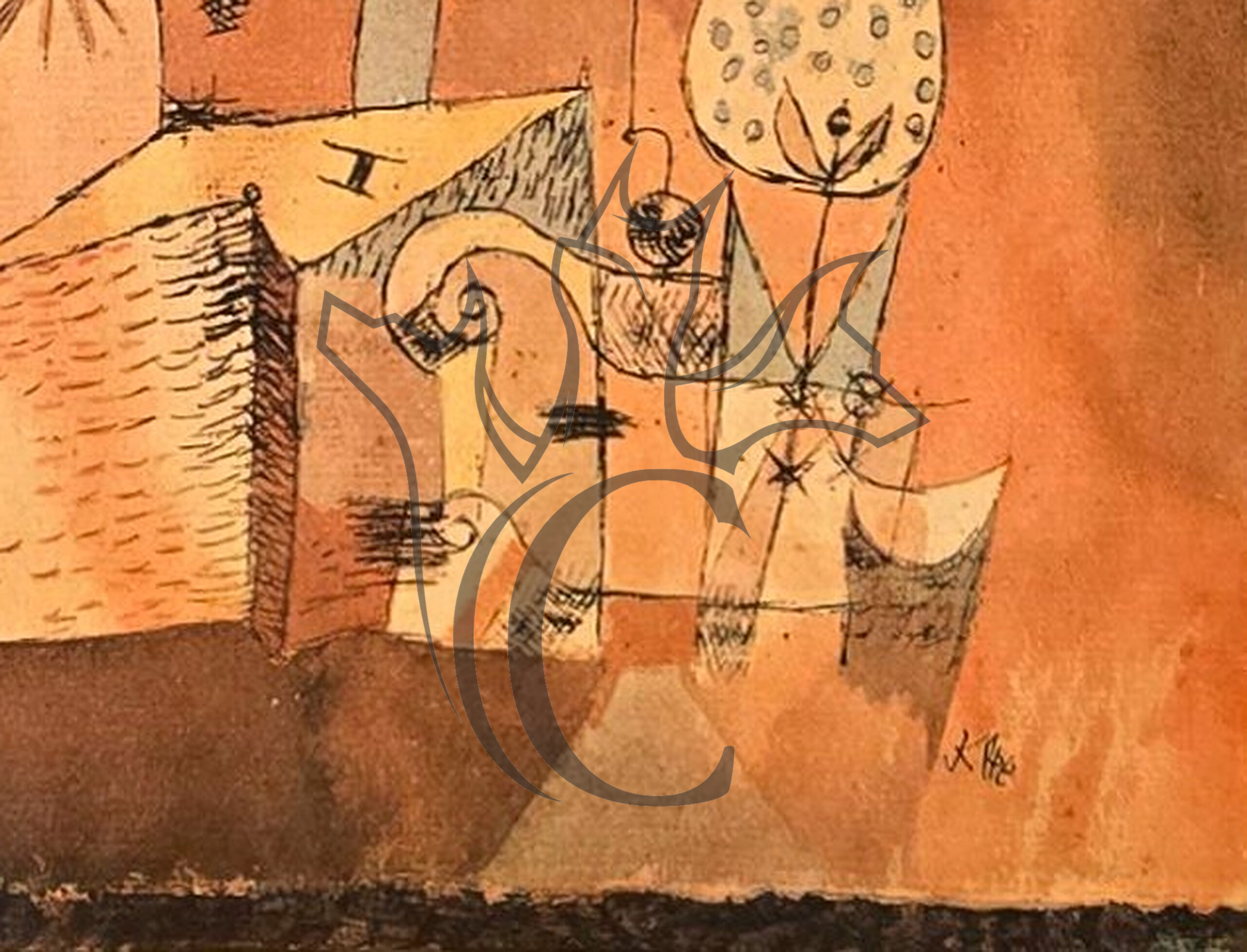
Plan einer Maschinenanlage 1920.163 (Plan of Machinery; French: Plan d’une installation de machines) is a 1964 lithograph and pochoir (hand-stenciled watercolor) after Paul Klee’s 1920 work of the same title. It was issued in the portfolio Paul Klee: 12 aquarelles, published in Paris by Berggruen & Cie and printed by Atelier Daniel Jacomet et Cie on Vélin de Rives in an edition of 500; this impression is numbered 28/500 in pencil at lower right. In fine black pen over translucent planes of terracotta, rust, umber and slate blue, Klee lays out an imaginary machine: rails and small wheels run across the top, cords and weights hang from them, a ball sits on a lever at the left, and funnels, boxes, arrows and the letters “a” and “p” read like the labels of an engineer’s diagram, while a crowned, tulip-like form stands at the right. A dark painted band runs along the lower edge. The signature “Klee” and the title line “1920. 163. Plan einer Maschinenanlage” are part of the printed work, the image sheet is mounted on a larger support sheet, and the verso is stamped “Editions Berggruen Fac-simile Jacomet”. An image-archive record describes the 1920 original as oil and watercolor on paper with a watercolor border strip, mounted on cardboard, 24.5 x 32 cm, in a private collection, so this edition reproduces it at very nearly its original size. The original dates from a pivotal year: Hans Goltz showed 362 of Klee’s works in a Munich retrospective in 1920, and on October 29 of that year Walter Gropius appointed him to the Bauhaus in Weimar, where he began teaching in January 1921. The printer, Daniel Jacomet (1894-1966), ran one of the most respected pochoir studios in Paris, known for stencil-colored facsimiles of watercolors by leading modern artists. Reference for the original: The Paul Klee: Catalogue Raisonné, Volume 3 (1919-1922), compiled by the Paul Klee Foundation, Museum of Fine Arts, Bern (Benteli / Thames & Hudson, 1999).
Paul Klee (1879-1940) was a Swiss-born German artist and one of the most original figures of twentieth-century modernism. Born in Münchenbuchsee near Bern, he studied in Munich, joined the circle of Der Blaue Reiter around Wassily Kandinsky and Franz Marc in 1911-12, and found his way to color on a 1914 journey to Tunisia. He taught at the Bauhaus in Weimar and Dessau from 1921 to 1931 and then at the Düsseldorf Academy, until the Nazi government dismissed him in 1933; he returned to Switzerland, and his work was later denounced in Germany as “degenerate”. Despite a debilitating illness, scleroderma, he worked with extraordinary intensity until his death in 1940. His output of some 10,000 works joins drawing, color theory, music, poetry and wit, and the Zentrum Paul Klee in Bern, opened in 2005, is dedicated to his legacy.
| Year | 1964 |
|---|---|
| Medium | Lithograph and Pochoir (hand-stenciled watercolor) on Vélin de Rives |
| Technique | Lithograph and Pochoir (hand-stenciled watercolor) on Vélin de Rives |
| Dimensions | Image: 9.8 x 13 inches (24.89 x 33.02 cm) |
| Edition | 28/500 |
| Signature | Signed in the plate |
| Certificate | Included |
| Framing | Framed |
| Condition | Good |
| SKU | 924802-2745 |
Paul Klee (18 December 1879 – 29 June 1940) was a Swiss-born German artist. His highly individual style was influenced by movements in art that included expressionism, cubism, and surrealism. Klee was a natural draftsman who experimented with and eventually deeply explored color theory, writing about it extensively; his lectures Writings on Form and Design Theory (Schriften zur Form und Gestaltungslehre), published in English as the Paul Klee Notebooks, are held to be as important for modern art as Leonardo da Vinci's A Treatise on Painting was for the Renaissance. He and his colleague, Russian painter Wassily Kandinsky, both taught at the Bauhaus school of art, design and architecture in Germany. His works reflect his dry humor and his sometimes childlike perspective, his personal moods and beliefs, and his musicality.
Each artwork is professionally packed and shipped fully insured. Returns accepted within 14 days of delivery in original condition. Contact the gallery for white-glove or international shipping quotes.
Our gallery team is here to help with any questions about this artwork.
Contact Gallery